
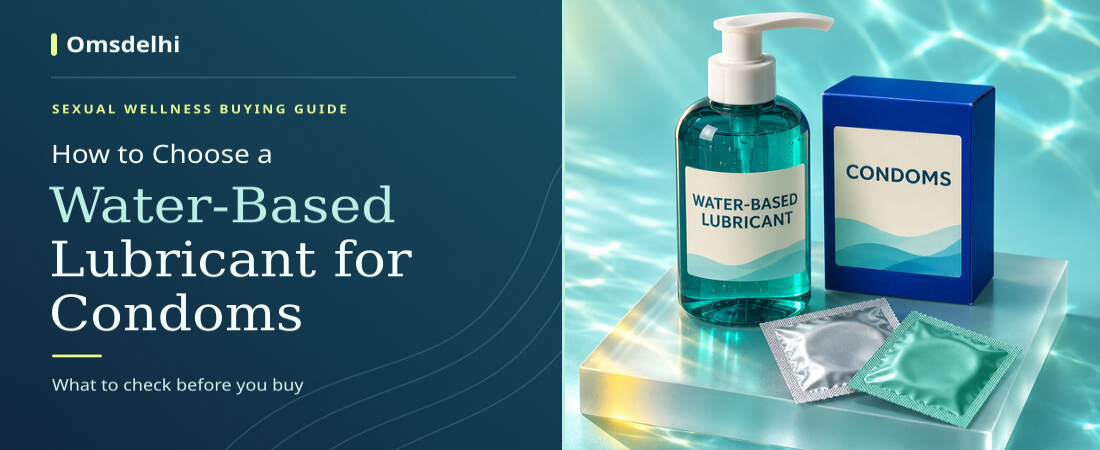
How to Choose a Water-Based Lubricant for Condoms
A tube marked “lubricating gel” can look like the right purchase until you read the back and discover it isn’t intended for use with condoms. The reverse can happen too. A product that looks thick or creamy in the photo may still be a water-based personal lubricant. The front of the pack tells you what the brand wants you to notice. The compatibility instructions tell you whether it belongs in your basket.
Start with the condom you plan to use. Find its material, then look for a water-based personal lubricant that the label says is suitable for that material. Once those two details are clear, you can compare what matters to you, whether that’s a lighter texture, an unfragranced formula or a bottle you’ll actually finish.
Read Both Labels Before Buying a Lubricant
Check the condom material first
Look for the material printed on the box or wrapper. Many external condoms are made from natural rubber latex, but brands can sell latex and non-latex options under similar names. A listing that says “ultra-thin”, “textured” or “regular fit” tells you about the style, not necessarily the material. If you’re shopping online, read the details for the exact variant you selected rather than assuming the main product photograph applies to every option.
For latex condoms, water-based personal lubricants are generally suitable when both manufacturers’ directions agree. Don’t use oil-based products such as coconut oil, petroleum jelly or massage oil with latex condoms because they can weaken the material. “Latex-free” isn’t a blanket exception. Oils can also damage polyisoprene condoms, so check the instructions for that specific product.
Match the lubricant to that material
“Water-based” describes the formula. “Compatible with latex condoms” tells you how the product can be used. Look for both if you’re pairing the lubricant with latex. If the page only says “intimate gel” or “personal care”, check the back-of-pack image or the manufacturer’s instructions. If you still can’t confirm what it’s meant for, choose a better-labelled option.
For example, suppose you’re comparing two similarly priced tubes. One is labelled “water-based personal lubricant, suitable for latex condoms”. The other is described as a “silky massage gel” and the listing gives no compatibility information. The first gives you a clear answer for a latex condom. A high star rating on the second doesn’t resolve what the label leaves out.
Don’t let a product review stand in for the label
Reviews can help you judge whether a pump leaks or whether other shoppers find a gel too thick. They’re less useful for confirming compatibility. A review may be about a different variant, and older photos can show a previous version of the packaging. If a product title, photo and description don’t agree, don’t guess which one is current. Ask for a clear photo of the directions on the pack you’ll actually receive, or choose a listing that makes the answer clear. Check the delivered product too, especially if the box design is different from the listing.
What to Compare Once You’ve Confirmed Compatibility
Texture and ingredients
The words “gel” and “liquid” are useful for comparing texture, but they don’t establish what the lubricant is made from. A thinner formula may be easier to spread. A thicker gel may be easier to put exactly where you want it. Neither is automatically a better choice. If you’ve used one successfully before, check that the new listing matches its exact name and formula rather than relying on packaging colour alone.
Look at added features separately. A warming, cooling, flavoured or fragranced version may be sold beside a plain one in nearly identical packaging. If you want a straightforward first purchase, choose the plain formula once you’ve checked compatibility and read the ingredient list for anything you already know you react to. An “unscented” or “sensitive” label doesn’t tell you whether you personally will tolerate a product.
Pack size and price per 100 ml
A bigger bottle isn’t always the best purchase. A smaller tube is useful when you’re trying a new texture or only expect to use it occasionally. If you’re buying a lubricant you already like, work out the price per 100 ml before choosing between sizes. That makes it easier to compare two listings that use different pack sizes.
For example, a 50 ml tube at ₹249 costs ₹498 per 100 ml. A 100 ml bottle at ₹399 has a lower unit price, even though it costs more upfront. These are illustrative prices, not store prices. If you’re unsure whether you’ll like the formula, the smaller tube may still be the better buy. Check whether a listing is for one bottle or a multipack before making the calculation. If one listing gives the net weight in grams and the other gives volume in millilitres, don’t compare the numbers directly. For a fair unit-price comparison, find listings that give quantities in the same unit.
The packaging you’ll actually use
Compare the dispenser as well as the contents. A pump may suit a bottle you keep at home. A compact tube with a cap may be easier to store. If you’re buying online, check the quantity in millilitres, the ingredient list and whether you can see the manufacturer’s directions. When it arrives, make sure the seal is intact and the product is within its expiry date before using it. Follow any storage or after-opening instructions on the pack.
How to Use Water-Based Lubricant With an External Condom
Check that the condom wrapper is intact and the condom is in date. Open the pack carefully and put on a new condom before genital contact, following the condom’s directions. If you want extra lubrication, apply a small amount of compatible lubricant to the outside of the condom as directed by the lubricant manufacturer. If friction returns, pause and add more as needed. Use a new condom each time.
If a condom breaks or slips off, stop and use a new one before continuing. If the break or slip may have led to pregnancy risk or STI exposure, contact a healthcare professional or sexual health service promptly. Lubricant reduces friction, but it doesn’t replace a condom or provide contraception or STI protection on its own.
When a Different Lubricant Isn’t the Whole Answer
Occasional friction and persistent discomfort are different problems. A water-based lubricant can help with occasional vaginal dryness during sex, while a vaginal moisturiser serves a different purpose. Don’t use a moisturiser in place of a personal lubricant unless its instructions confirm it’s appropriate for that use and compatible with your condom.
Stop using a product if it causes burning or irritation. If dryness or pain keeps returning, or you notice unusual discharge or bleeding, speak with a healthcare professional instead of trying one formula after another.
Shop Water-Based Lubricants and Condoms at Omsdelhi
Omsdelhi is an online sexual wellness store where you can browse personal lubricants and wellness oils and compare condom options before ordering. When buying the two together, open both listings and confirm the condom material and lubricant compatibility before adding them to your cart.
Orders are sent in discreet packaging, and free shipping is available on eligible orders above ₹1,000. Check your PIN code and delivery total at checkout. If you’re considering a larger pack just to reach the threshold, compare the final cost with what you would pay for the smaller pack plus shipping. OMSDelhi
Frequently Asked Questions
Can I add water-based lubricant to a pre-lubricated condom?
Yes, if the additional lubricant is compatible with the condom. A pre-lubricated condom already has lubricant on it, so you may not need more. If you do, follow both packs’ instructions and apply the compatible lubricant to the outside of the external condom.
Is a water-based gel the same as a water-based liquid?
Both can be water-based, but texture can differ. A gel generally feels thicker than a liquid. For condom use, the important detail is whether the particular formula is compatible with your condom material. Choose the texture after you’ve checked that.
Can I use a water-based lubricant with a non-latex condom?
Check the directions for the specific condom. Non-latex describes what it doesn’t contain, not what it’s made from or which lubricants it works with. Match the information on both packs instead of relying on the words “latex-free”.
Can I use silicone-based lubricant instead of water-based lubricant?
Yes, silicone-based lubricant is another option for many latex condoms. Check the directions on both products. If you’re comparing formulas for use with an accessory as well, read its care instructions separately, since condom and accessory compatibility are different questions.
What if the lubricant feels sticky during use?
If it starts to feel tacky and there’s more friction, pause. Check the directions and add a little more compatible lubricant if needed. If the issue is burning or irritation rather than texture, stop using it.
The simplest buying rule is to match the two labels first and compare price and texture second. That gives you a better basis for choosing than the product name, the photo or the size of the discount.









Leave a Reply
You must be logged in to post a comment.